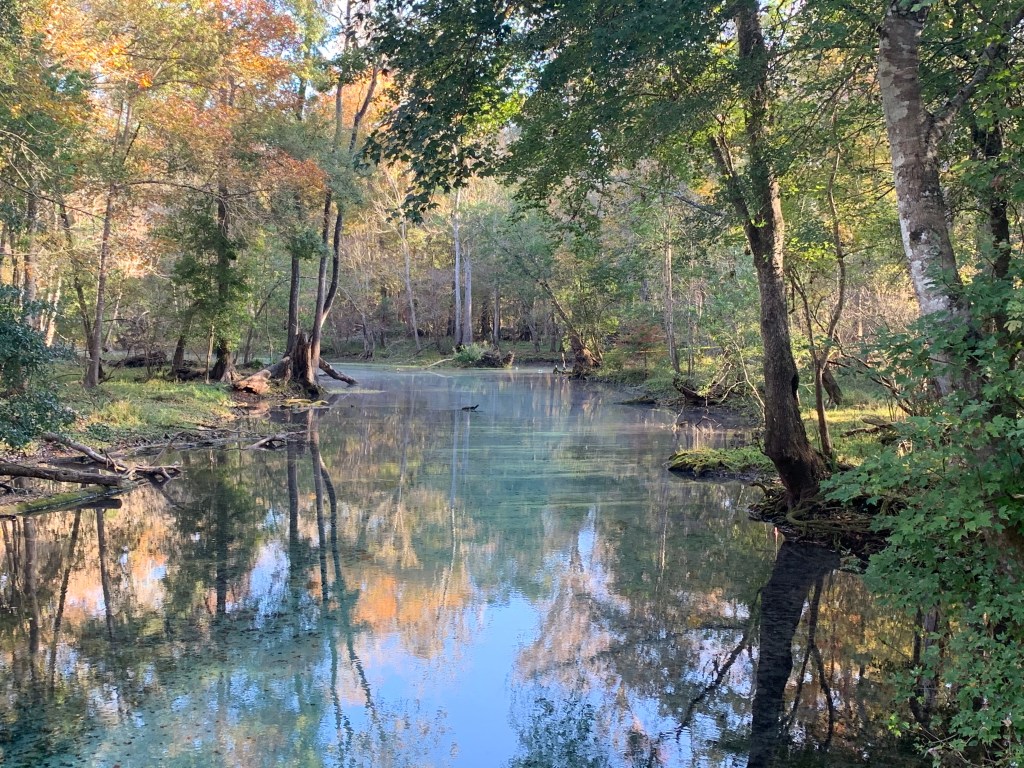
Photo: Gilchrist Blue Spring Run in the Fall
Diveintospringssav.com is a central location hub for info about Submerged Aquatic Vegetation as well as resources for educators and anyone/everyone to learn more about the essential role these plants play in Florida springs ecosystems.
This website was born out of the research efforts and products of a project generously funded by the Fish & Wildlife Foundation of Florida’s Protect Florida Springs Tag Grant program. Our project is titled “Investigating Submerged Aquatic Vegetation
Macroinvertebrate Communities in Florida Springs”.
About the project
Investigating Submerged Aquatic Vegetation
Macroinvertebrate Communities in Florida Springs
Florida springs are globally recognized for their unique ecological and aesthetic value. At the base of the food web, submerged aquatic vegetation (SAV) plays a vital role in maintaining biodiversity by providing habitat structure, refuge, and forage for many species. SAV supports primary consumers such as turtles and the federally threatened Florida Manatee. Another important group of herbivores—macroinvertebrate grazers like snails, insect larvae, and amphipods—are often overlooked. These organisms form a key link in the food web, transferring energy from primary producers to higher trophic levels including fish, birds, amphibians, and reptiles.
Macroinvertebrate diversity and abundance are common indicators of ecosystem health, yet their relationships with specific SAV species remain poorly understood. Different SAV species vary in structural complexity, which influences the invertebrate communities they support. For example, Red Ludwigia (Ludwigia repens), with its complex branching, offers more niche space for tiny organisms than simpler plants like eelgrass (Vallisneria americana). These associations can have cascading effects on food webs and ecosystem resilience.
This project will address that gap through a field study in four springs: Gilchrist Blue, Naked Spring, Ichetucknee, and Little Fanning, documenting macroinvertebrate diversity and abundance associated with SAV. Results will generate species-specific data to improve understanding of ecosystem structure and function. Along with these data, the project team is developing learning tools such as a “Springs Virtual Snorkel Tour” taking viewers underwater on a guided botanical tour of springs SAV habitats. K-12 lesson plans that align with state learning will be developed and posted to the website to accompany these virtual learning tools. Keep an eye out for these resources coming soon before the 2026-2027 school year!
About the Research Team
Our research team is based out of Mobile, Alabama in the University of South Alabama’s Stokes School of Marine and Environmental Sciences and Dauphin Island Sea Lab in Dr. Charlie Martin’s Estuarine Ecology Lab. In the lab, we conduct broad and applied ecological research focused on the conservation of marine and estuarine ecosystems. Specifically, we seek to identify the effects of anthropogenic stressors on coastal ecosystems using field-oriented and experimental approaches. Our work focuses on question-driven research, and we examine a broad range of organisms/systems that provide novel ecological insight rather than focusing on organism-specific hypotheses. The ultimate objective of our research is to gain a fundamental understanding of the ecological processes structuring natural ecosystems, particularly how anthropogenic perturbations have modified these processes.
About the Project Lead
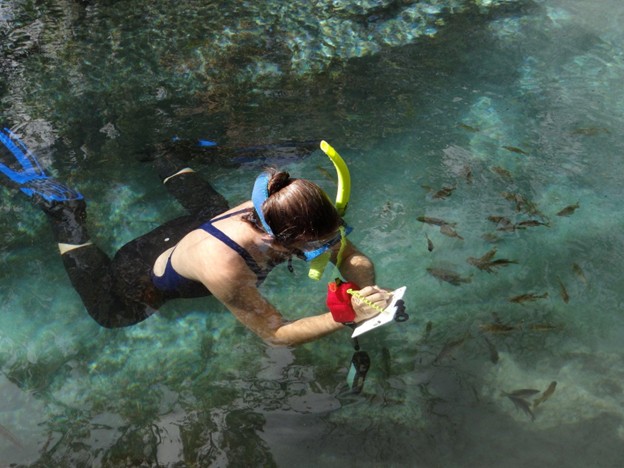
Zoey Hendrickson is a PhD student at the University of South Alabama’s Stokes School of Marine and Environmental Sciences and Dauphin Island Sea Lab in Dr. Charlie Martin’s research lab. She received her Master’s degree in Fisheries and Aquatic Sciences from the University of Florida and her Bachelor of Science in Biology from Florida State University. Originally from North Central Florida, Zoey gained a deep appreciation for the springs in her formative years as well as in her professional career conducting ecological monitoring in over 30 different springs along the Santa Fe River, Suwannee Rivers, and across the state of Florida. This research project is part of her dissertation work titled “Ecological Consequences of Environmental Change: Understanding New Species in New Areas Through Habitat Structure and Community Responses” studying everything from native and exotic aquatic plants, to novel and non-native fish species. Zoey is passionate about aquatic ecology – especially Florida springs – and hopes that this website will help to share her passion for aquatic ecosystem education with anyone curious about Florida’s amazing springs!
Thank you for visiting DiveintospringsSAV.com!
Are you an educator or springs enthusiast? Email us with any questions at zhenrickson@disl.org
Follow the Estuarine Ecology Lab on Instagram! @est_eco_lab
 Welcome to DiveintospringsSAV.com